
Case study
Migrating from a serverless architecture to a scalable cloud infrastructure: a real case
schedule3 min
calendar_today15 May 2025
syncCaricamento...
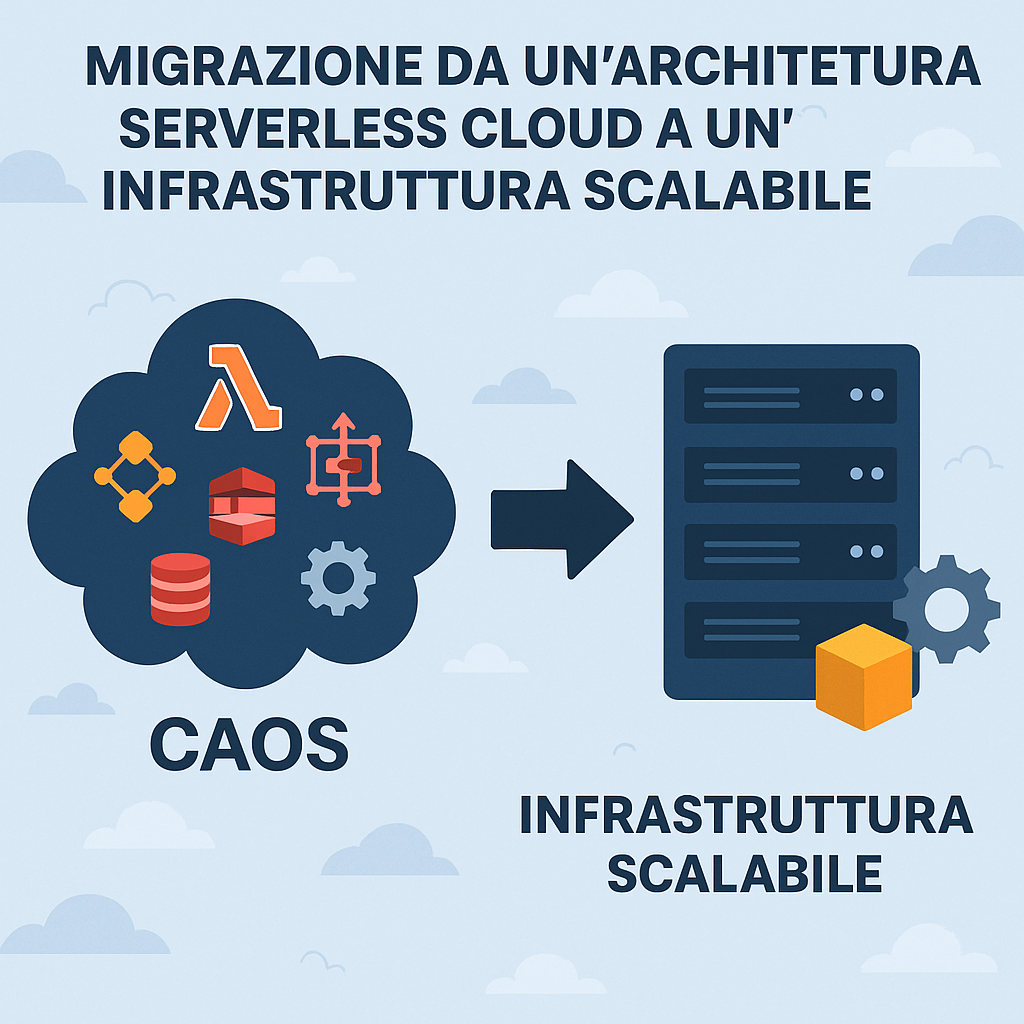
Many digital projects start with the goal of validating an idea quickly: you begin with a serverless stack, use the cloud to keep initial costs down, and focus exclusively on functionality. When time-to-market is crucial, serverless looks like the perfect solution.
It is a sensible strategy… up to a point.
If it is not accompanied by an evolutionary vision of the cloud architecture, that same initial choice can become the project's weak point.
What is an MVP (Minimum Viable Product)?
MVP stands for Minimum Viable Product, that is, the smallest working product. It is a simplified version of an application or service, created to test a business idea quickly and at limited cost.
The goal of an MVP is to verify that the idea works, that there is real market interest and that users are willing to use it. However, an MVP is not meant to last, but to learn from and then evolve.
The project context: from MVP to mission-critical system
One of our clients, a fast-growing tech company, contacted us after increasingly frequent problems with the stability and maintainability of its cloud infrastructure. The system, born as an MVP based entirely on serverless technologies, had been carried forward without rethinking the architecture, despite the continuous growth in users and features.
The main issues we found in the serverless environment
- Lambda functions with strong mutual dependencies, hard to manage and test
- Timeouts and errors caused by cold starts and execution time limits
- Costs increasingly hard to predict because of automatic scaling
- Poor observability: scattered logs and no unified monitoring system
- Technology lock-in to a single cloud provider, making it hard to migrate or extend
Our approach: a gradual transition plan towards a scalable infrastructure
To avoid service interruptions, we drew up a step-by-step migration plan that made it possible to modernize the infrastructure without compromising operations.
The main activities we carried out:
- Containing and consolidating the Lambda functions, eliminating fragmentation
- Containerizing the core services with AWS Fargate, improving the predictability of performance
- Introducing advanced observability tools, with CloudWatch, OpenTelemetry and centralized alerting
- Clear separation of the development, staging and production environments, with well-defined security policies
- Managing the infrastructure as code (IaC) with Terraform, to ensure versioning, consistency and governance
The benefits of the new cloud architecture
Thanks to the new architecture:
- The development team was able to work with more autonomy and visibility on well-structured environments
- The system became more stable, scalable and monitorable, with a positive impact on users and stakeholders
- The client was able to integrate new features in less time and with lower risk
- Infrastructure costs stabilized, with greater transparency on consumption
Conclusions: serverless is a tool, not a strategy
Serverless is not a mistake. On the contrary, it can be a formidable ally in the early phase of a project, allowing rapid iterations and effective market tests. But it has to be managed with the awareness that, once the MVP phase is over, you need a strategy for evolving the infrastructure in the cloud.
At Shellonback we support startups and technology companies in the transition from experimental projects to robust, reliable solutions designed to grow.
If you are facing a similar problem or need a technical assessment of your current infrastructure, contact us through our dedicated page:
https://www.shellonback.com/en/contacts
We will be happy to hear your story and help you build the foundations for the future of your project.