
Case study
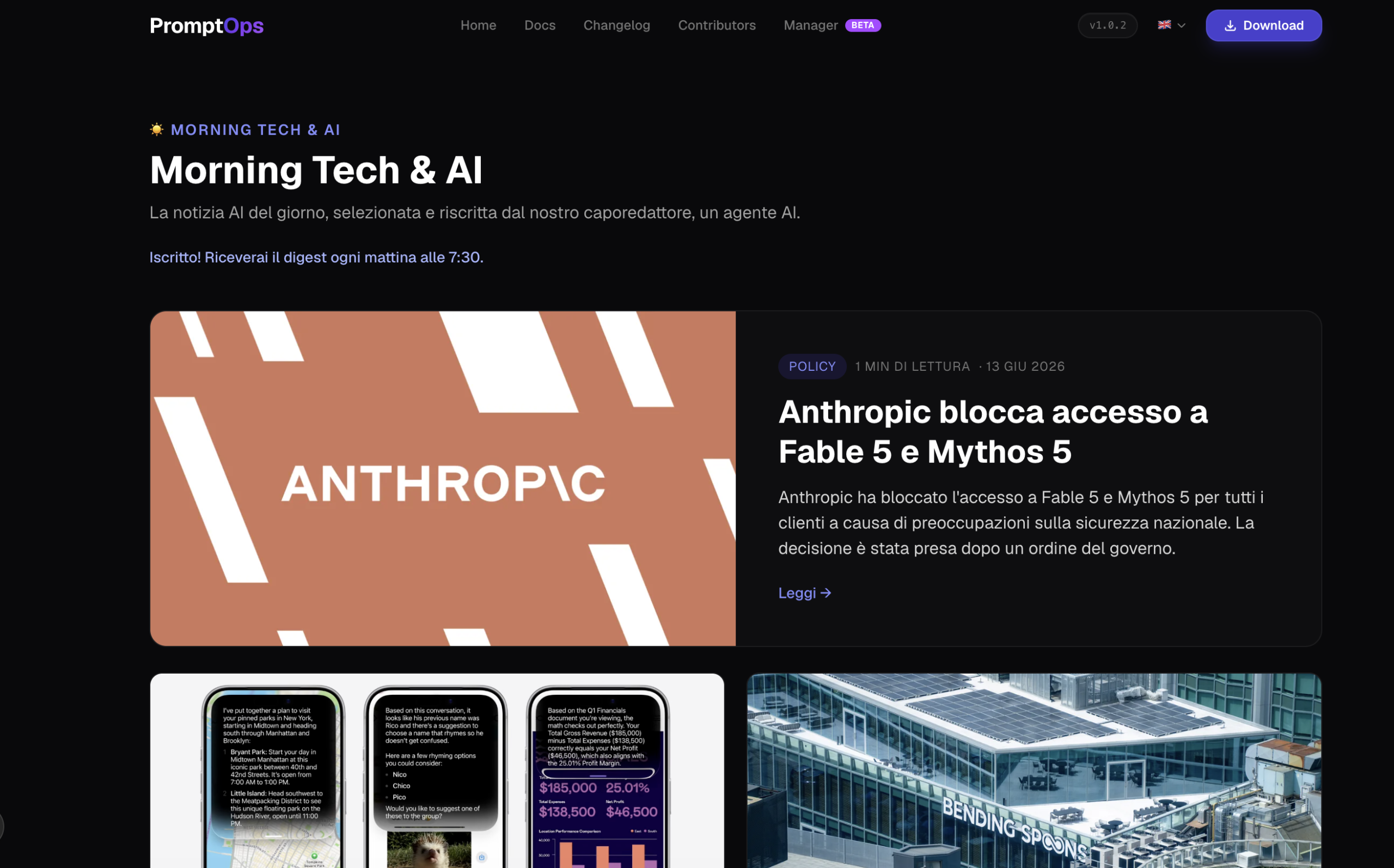
Morning Tech & AI newsletter: a fully automated newsroom built on AWS and AI
schedule4 min
calendar_today26 June 2026
syncCaricamento...
Introduction
Artificial intelligence is often described as a simple chatbot or as a tool for writing text.
In practice, the real value emerges when it becomes an integral part of a business process.
Morning Tech & AI comes from exactly this idea: showing that it is possible to design a fully automated workflow in which AI does not perform a single task, but works inside a pipeline made up of several cloud services, business logic and automations.
The goal was not to build a newsletter.
The goal was to design a fully automated digital newsroom.
A platform able to collect information, evaluate it, produce content, publish it and distribute it without any human intervention.
Every morning the system starts automatically, produces the day's edition and ends its execution.
The problem
Every day thousands of news items are published about:
- artificial intelligence
- cloud computing
- cyber security
- open source
- software development
- DevOps
- startups
- Big Tech
Following all these sources takes time.
Telling the news that really matters apart from the noise is even harder.
For this reason we decided to automate the entire editorial process.
We did not simply want to summarize articles.
We wanted to build a system able to behave like a small newsroom.
The goals
The project had to be able to:
- consult dozens of different sources;
- avoid duplicate news;
- automatically choose the most interesting items;
- produce bilingual content;
- always keep the original source;
- create images for social media;
- publish the articles;
- send the newsletter to subscribers;
- run without operators.
All of this every morning, completely autonomously.
The architecture
The entire solution is built in the cloud using fully managed AWS services.
Amazon EventBridge Scheduler
At 06:00 the pipeline run is scheduled automatically.
There are no cron jobs installed on dedicated servers.
The infrastructure is activated only when it is needed.
Amazon ECS Fargate
The pipeline runs inside Docker containers.
Each task is started automatically, completes its work and is terminated.
This approach means paying only for the processing time actually used.
Amazon ECR
The Docker images are versioned and distributed through Elastic Container Registry.
Each new release can be published without changing the infrastructure.
AWS Secrets Manager
All sensitive configuration is stored centrally.
This includes:
- AI API keys
- SMTP credentials
- database connections
- application configuration
No sensitive data is present in the code.
Amazon S3
The automatically generated images are stored on S3.
They are then used for:
- newsletter
- website
- social networks
Amazon RDS
The database stores:
- articles
- translations
- categories
- subscribers
- processing history
- statistics
CloudWatch
Every run is monitored through centralized logs.
Any errors can be identified immediately.
GitHub Actions
At the end of the pipeline the static site is deployed automatically.
No manual intervention is needed.
The workflow
06:00 — Collection
The pipeline consults dozens of carefully selected RSS feeds.
Each article is normalized and compared with those already collected.
Duplicate news is removed automatically by comparing URLs and title similarity.
06:10 — AI Editor
At this point Grok comes into play.
The model analyzes all the news collected.
It then chooses the three most relevant items, respecting a few constraints:
- different topics;
- technological interest;
- presence of images;
- quality of the source.
The behavior is very similar to that of an editor-in-chief.
06:20 — AI Writer
A second AI stage produces:
- title
- article
- Italian translation
- English translation
- SEO slug
- meta description
Every prompt is designed to avoid hallucinations.
The information is reworked while always keeping the original source.
06:35 — Social content generation
The system automatically produces:
- vertical covers
- branded images
- captions
- hashtags
- localized content
The images are stored on Amazon S3.
06:50 — Publication
Once content production is finished, publication starts automatically.
GitHub Actions rebuilds the static site.
The cache is invalidated.
The day's edition is online.
07:30 — Newsletter
The last stage is distribution.
Each user automatically receives the newsletter in the language chosen at sign-up.
The entire workflow ends without any human intervention.
The result
What arrives in the inbox every morning is a newsletter.
Behind that newsletter, however, dozens of software components work together.
AI is not a button.
It is one of the elements that make up a much broader workflow.
The real innovation is not the language model.
It is the orchestration of the entire process.
Beyond the newsletter: where can the same approach be applied?
Morning Tech & AI is just one case study.
The same architectural model can be applied to a great many business processes.
For example:
- automatic production of management reports;
- competitor monitoring;
- market price analysis;
- collection of public tenders;
- regulatory monitoring;
- customized press reviews;
- generation of technical documentation;
- automatic ticket classification;
- customer support;
- document management;
- quality control;
- IoT analysis;
- processing of industrial data;
- financial reporting;
- automation of HR processes;
- contract checks;
- generation of commercial offers;
- analysis of application logs;
- company knowledge management.
In all these cases the principle is the same.
Artificial intelligence does not replace software.
It completes it.
Each AI agent performs a well-defined task inside a pipeline designed according to defined rules, checks and goals.
AI therefore becomes a component of the software architecture, not an isolated element.
Our approach
At SHELLONBACK we design solutions in which cloud, AI and software development work together.
We do not build simple integrations with language models.
We design intelligent workflows, cloud platforms and automation systems that reduce repetitive tasks, improve the quality of processes and let companies spend their time on decisions, not on manual operations.
Morning Tech & AI is one of many examples of how we imagine the software of the coming years: fewer repetitive tasks, more orchestration, more automation and a concrete use of artificial intelligence inside business processes.